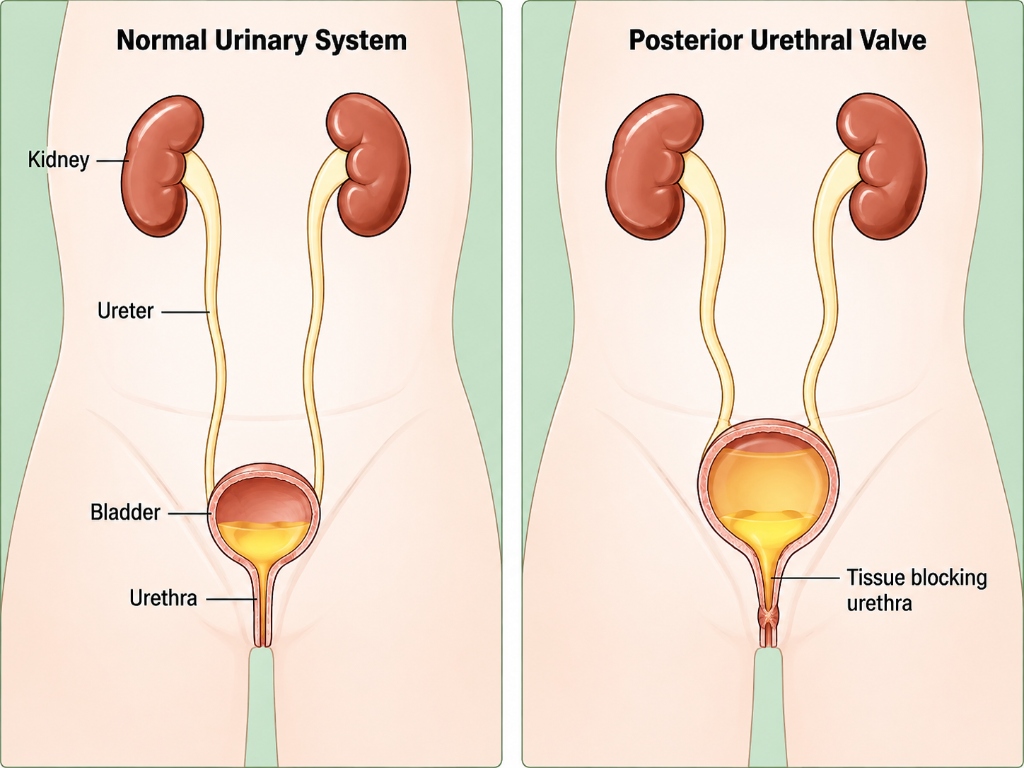
A posterior urethral valve (PUV) is a serious congenital condition occurring in newborn boys where obstructive tissue leaflets block normal urine flow from the bladder. The resulting backpressure can lead to severe bilateral hydronéphrose, bladder thickening, and secondary reflux vésico-urétéral. Seeking early Posterior Urethral Valve treatment in Delhi is critical to relieve urinary obstruction and preserve kidney function in newborns.
PUV is a developmental anomaly occurring early during fetal gestation:
Symptoms range from prenatal ultrasound findings to postnatal urinary signs:
Les valves urétrales postérieures (VUP) constituent une urgence urologique chez les nouveau-nés de sexe masculin. Le blocage sévère peut entraîner une détérioration rapide des reins et de la vessie. Un soulagement immédiat de l'obstruction est essentiel pour arrêter les dommages supplémentaires et donner aux reins une chance de récupérer. Un traitement retardé peut entraîner une insuffisance rénale terminale, nécessitant une dialyse ou une transplantation rénale à un jeune âge.
Treating PUV is a long-term commitment. Even after the valves are successfully ablated, the child may have a "valve bladder" that functions poorly. Our comprehensive care includes regular urodynamic studies, kidney function tests, and continuous bladder management to protect the upper urinary tract and ensure the best long-term outcome for your child.
Traitement primaire à l'aide d'un cystoscope miniature pour couper les valves obstructives sans incisions externes.
Une ouverture chirurgicale temporaire dans la vessie pour permettre à l'urine de s'écouler librement chez les nourrissons très petits ou malades.
Soins à long terme impliquant des médicaments et une cathétérisation pour gérer la dysfonction vésicale persistante.
Après le diagnostic, un petit cathéter est placé pour drainer immédiatement la vessie et permettre aux reins de commencer à récupérer avant la chirurgie.
Une procédure ambulatoire où les valves sont retirées avec précision à l'aide d'un cystoscope néonatal. Aucune incision externe n'est pratiquée.
Des contrôles réguliers sont essentiels pour surveiller la croissance des reins et la fonction de la vessie à mesure que l'enfant grandit jusqu'à l'adolescence.
"Our son was diagnosed with PUV at birth. Seeking Posterior Urethral Valve treatment in Delhi with Dr. Sujit saved his kidneys. His endoscopic surgical skills are truly world-class."
"Des conseils d'experts pour une condition très effrayante. Le Dr Chowdhary surveille notre fils depuis 5 ans maintenant, et sa santé est parfaite."
"Dr. Chowdhary is the most dedicated Posterior Urethral Valve doctor in Delhi. The valve ablation was successful, and his compassionate team guided us through every step of post-op care."
"Trouver un médecin qui comprenne vraiment la complexité des VUP a été un soulagement. La santé de notre fils s'est considérablement améliorée sous ses soins."
"We traveled from another state just for Dr. Chowdhary. His approach to managing valve bladder function is very scientific, methodical, and deeply caring."
"Le personnel infirmier et le Dr Sujit forment une équipe fantastique. Ils ont géré la chirurgie de notre nourrisson avec tant de soin et de chaleur. Fortement recommandé à tous les parents."
When parents seek an experienced Posterior Urethral Valve doctor in Delhi, comprehensive neonatal endoscopic valve ablation, advanced urodynamics, and long-term valve bladder protocols are essential to safeguard the child's long-term renal health.
Posterior Urethral Valves (PUV) are abnormal tissue folds in the posterior urethra of male infants that act as a one-way valve, obstructing urine flow out of the bladder and causing severe urinary backpressure on the kidneys.
PUV is often suspected on prenatal ultrasound showing bilateral hydronephrosis (swollen kidneys) and low amniotic fluid (oligohydramnios). Postnatally, it is confirmed via a Voiding Cystourethrogram (VCUG / MCUG) imaging study.
Initial management involves emergency bladder decompression using a soft catheter to relieve pressure and stabilize kidney function, followed by endoscopic primary valve ablation.
Endoscopic valve ablation is a daycare keyhole procedure. Using a miniature neonatal cystoscope inserted through the urethra, the surgeon precisely cuts or cauterizes the obstructive valve leaflets without any external skin incisions.
Even after successful valve ablation, many children experience persistent bladder wall thickening or hypertonia ("valve bladder syndrome"). Long-term management involves regular urodynamic studies, prophylactic antibiotics, and anticholinergic medications to protect the kidneys.
In premature or extremely small infants where endoscopic cystoscopy cannot be safely performed, a temporary vesicostomy (a small cutaneous opening in the lower abdomen draining the bladder) is created to relieve obstruction until the baby grows.
Yes, early valve ablation combined with lifelong pediatric urology monitoring protects renal function, allows normal growth, and helps boys achieve healthy urinary control and quality of life.
L'ablation endoscopique des valves soulage l'obstruction de la vessie et protège la santé rénale. Prenez rendez-vous dès aujourd'hui.
D6, Club, 2, en face de Vasant Vihar, Vasant Vihar, New Delhi, Delhi 110057
+91 98732 06761